Article 03
"Something Old, Something New "
By Eric Ching
March 6th, 2005
A flash of curved horns caught our eye, and we quickly spotted the silhouetted shape in the shadows off the right side of the road. The driver rolled the hunting car around the bend before slowing to a stop behind a large termite mound. We quietly got out and I followed my PH on the approach. Peeking around the right side of the mound, we spotted the object of our hunt no more than twenty yards ahead: a Zambian sable with dramatic back-sweeping horns. I’d checked my rifle’s zero just five minutes earlier. I had to decide quickly whether to end the hunt right now.
I was a guest of Sable Safaris, a Zambian joint venture between Cheetah Safaris and Bush Africa Safaris of Limpopo Province in South Africa. I was making this trip primarily to accompany the four hunters of the inaugural MCA African Safari on their first African plains game hunt with Schalk van Heerden, owner and PH, in South Africa, which I’d arranged. At my request, Schalk set up this side trip to Zambia to hunt a sable (Hippotragus niger) while the others got started on their African adventure, and I would join them later in the week to photograph and videotape their experience.
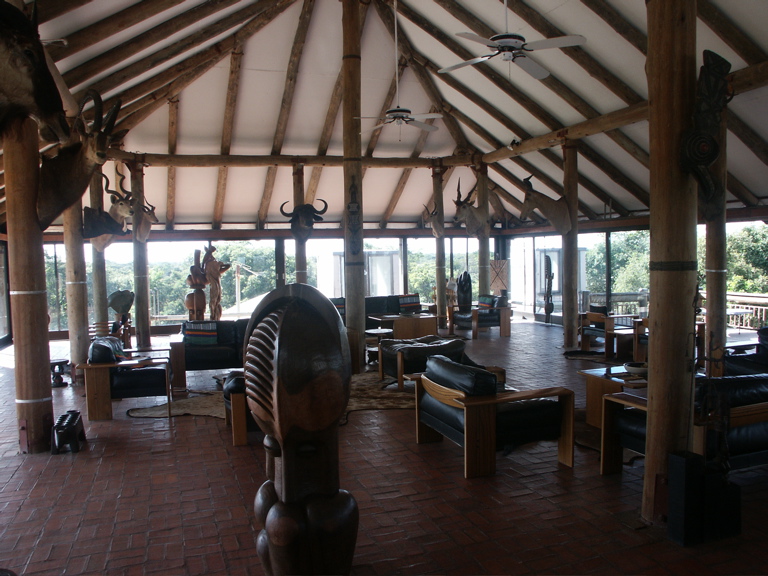
The Lodge.
A year and a half earlier at the Safari Club International Hunters’ Convention in Reno, Nevada, Schalk had asked me what rifle I was bringing for the sable hunt. “A Blaser R93 Synthetic in 9.3x62 with 286-grain Nosler Partitions,” I informed him. He smiled and nodded his approval. “The old Boer cartridge,” he commented. “My father hunted a lot with one of those.”
The 9.3x62 is perhaps the epitome of an old-fashioned cartridge that performs beyond its paper ballistics without all of the new-fangled features that followed. Designed by Otto Bock around 1905 as a general purpose round that could kill the wide variety of big and often dangerous game of Africa, it did exactly that reliably without belts, fat cases, or high velocities. I found it intriguing to be using this 100-year-old low-tech cartridge in the decidedly modern and high-tech Blaser R93 Synthetic.
Over the following months I worked on developing a load with the 286-grain Nosler Partitions. I’ve come to rely on Nosler Partitions as my “go-to” bullet for hunting, as they are reliably accurate and deadly on game. The 9.3x62 cartridge typically drives a 286-grain bullet about 2350 feet per second out of a 24-inch or 60-centimeter barrel. I wanted to match that performance, suitably adjusted downward to the Blaser’s 22-inch barrel length. If I could achieve 2300 feet per second with good accuracy, I’d be very satisfied.
I got the best combination of velocity and accuracy with IMR 4895 in initial testing. Working up gradually with that powder, group sizes steadily decreased as I approached 57 grains, then suddenly expanded beyond that point. As it turned out, 57 grains generated an average velocity of 2335 feet per second and three-shot group sizes of one-half inch at 100 yards, exceeding my expectations. I saw no reason to do further development.
I loaded up enough rounds to zero the two Leupold Vari-X III 1.5-5X scopes in Blaser QD mounts that would accompany the rifle to Africa, and to use in practice. When that was accomplished, I made up a final batch of 40 rounds for the hunt a few weeks before departing.
After 40 hours of travel encompassing four countries, three flights, and two layovers, I was immensely grateful to arrive at last at the gates of Chaminuka Nature Preserve late on a Sunday afternoon. Located only 45 minutes from Lusaka’s airport, it is primarily a game viewing preserve and conference center, but allows a limited amount of hunting to keep the game populations under control. Eddie Wentzel, one of Schalk’s professional hunters (PHs), had picked me up at the airport and would be my guide for this hunt.
Before going to sleep that night, I pulled out the factory hard-shell Blaser case and opened it to find that it had protected its contents well, with only minor scratching on the outside of the case to boot. I snugged the barrel and stock together and mounted the scope, checking that it was still set at 3X. After attaching a Safari Ching Sling I slipped the rifle into a soft case for protection while in the vehicle and went to bed with the calls of lions and hyena drifting over the camp.
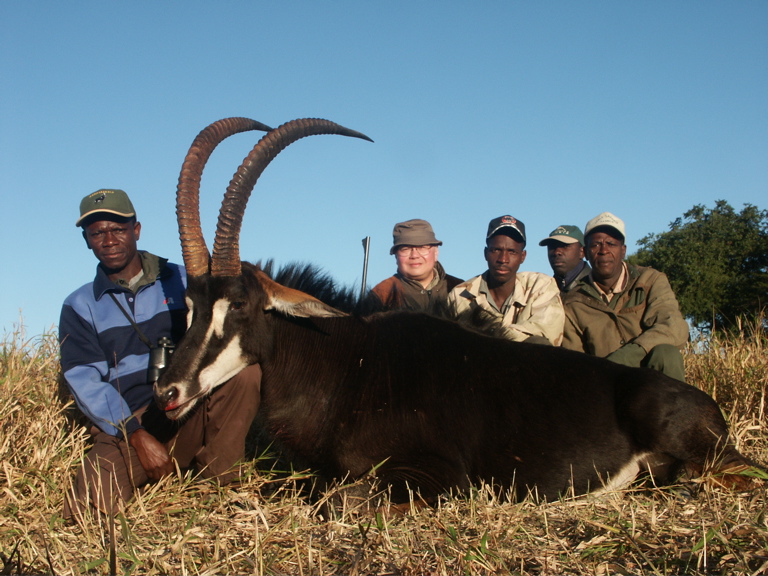
Eric Ching, the trackers and skinners with Eric's Sable.
A good night’s rest and anticipation of the hunt banished my exhaustion from the long trip. We mounted up as the morning glow gradually pushed back the night sky, and headed out into the dawn of my first day in Zambia. Chaminuka’s property includes a variety of habitats—from reed-fringed lakes to bushveld to grasslands—and supports a wide variety of game. In addition to the animals I was used to seeing in South Africa, Chaminuka treated me to my first sights of red lechwe grazing along the lake shores; tssesebe watching us warily from tree-covered rocky mounds; Lichtenstein’s hartebeest bounding away as we drove by; roan grazing placidly among the trees along the road; a diminutive oribi scuttling away through the high grass; sturdy Defassa waterbuck eyeing us defiantly; dainty puku, one of Zambia’s distinctive antelopes; beautifully russet-colored and white-spotted Chobe bushbuck; and, of course, the magnificent sable. I also saw thatch grass for the first time, the tops of which whisked by above my head as we drove through it, even though I was sitting in the high hunting seat of the truck.
We stopped after driving about half an hour without having seen a bull sable, and the trackers set up a makeshift target on the side of a termite mound about 80 yards away. Two shots from the Blaser confirmed that the rifle and scope had survived the rigors of international travel and were still perfectly aligned. By now the sun had burned off the morning chill. I shed my jacket, filled my rifle’s magazine, chambered a round, decocked the safety, and flipped my mental switch from scouting to hunting as we started off again. I found it very reassuring to be able to completely deactivate the firing mechanism while riding in the vehicle with two PHs and two trackers all around me, yet be ready to fire in less than the time it would take to mount the rifle to my shoulder.
Five minutes later we were peering around the side of the termite mound at a 38-inch sable bull lounging in the shade, completely oblivious to our presence. “Do you want to take him?” Eddie whispered, “He’s a nice one.” After a moment’s reflection, I decided it was just too soon to end the hunt. I had three days ahead of me, and had a good chance at something a bit larger. “I’ll pass on this one,” I replied, “We’ve got plenty of time.” He nodded in agreement, and we sneaked back behind the termite mound and returned to the truck, the quick encounter creating an air of optimism among the crew.
Of course, any astute hunter should know exactly what happened next: the wind picked up shortly thereafter, causing much of the game to bed down in the thickets the rest of the day, hidden from our searching eyes. You can bet that I was having second thoughts about my morning’s decision by the time the sun was setting.
At the end of the day, however, a quick stop at a field near the lodge gave us hope for the morning. The sun had slipped below the horizon and grey shadows were quickly fading into black. To our surprise, there was a small group of sable in the open—and one of them was a bull. There was not enough light to shoot—we could barely make them out with our binoculars—but from what we could see the bull was promising and Eddie said that we’d be back at dawn to see if they were still around. “Don’t worry,” he assured me, “you’ll have your sable within half an hour of sunrise tomorrow.” Given our experience throughout the day, I was somewhat skeptical, but still inclined to be optimistic. I drifted off to sleep that night with visions of that sable bull I had passed up in my mind’s eye.
It was still dark the next morning when the attendant rolled the heavy steel gate aside to let us depart. We were all eager to see whether the sable herd would still be in the field where we had left them the night before.
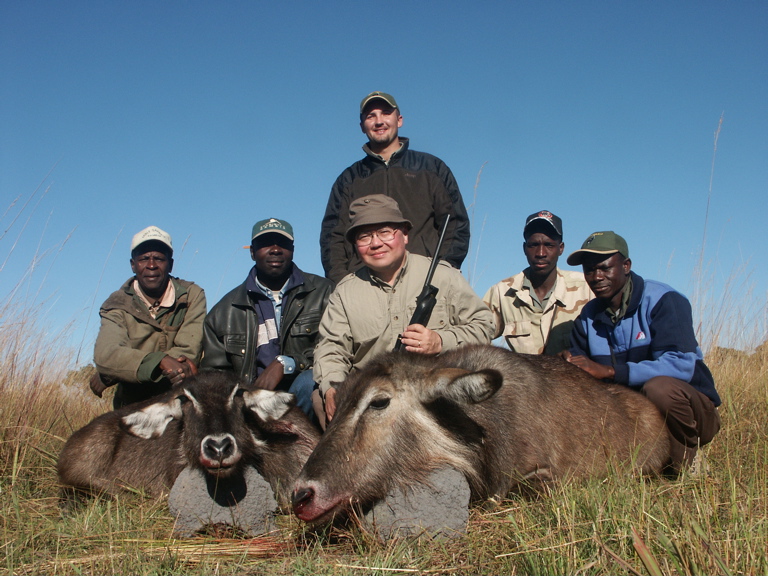
Eric and the crew with the two Waterbuck cows mentioned in the article.
By the time we approached the tree line fringing the field we could see well enough by the pre-dawn half-light, but a heavy ground fog still slumbered over the area, coating everything with a sheen of moisture and muffling all sounds. We slowed to a crawl as we made our way along the trail through the trees, straining our eyes to catch a glimpse of scimitar horns. We emerged at the edge of the field and, to our delight; the sable herd was still there, ghostly figures partially obscured by the drifting fog. Eddie quickly judged the bull through his binoculars as another 38-incher, but he also noticed a solitary bull standing off from the group about 30 yards to our right. “Let’s take a look at him,” Eddie suggested in a whisper, and I readily agreed.
We slowly reversed the truck back into the trees, drove over to the next trail, and crept our way to the edge of the field again. I already had my support elbow slipped into the Safari Ching Sling and my thumb on the Blaser’s cocking lever. As soon as we spotted the lone bull, Eddie threw up his binoculars and after a couple of seconds said, “He’s big. Take him.”
The bull was a large, dark figure in the morning mist, about 60 yards away, facing us and angling slightly to our left. I snapped the rifle to my shoulder, placed the crosshairs on its chest just inside and above the point of its near shoulder, and touched off the round. At the shot the sable crumpled straight down. I immediately cycled the bolt, but a follow-up shot was unnecessary. The sable picked up its head slowly, making a valiant effort to rise, but a moment later it succumbed to the inevitable.
Everyone in the truck seemed to do a double-take at the one-shot drop, and then grins broke out all around. Almost as if on cue, as we drove into the field, shafts of sunlight shot out from between the trees behind us through the fog as the sun peeked over the horizon. Eddie commented with a grin, “I told you that you’d have your sable within half an hour this morning.”
The bull was in obviously good condition with a shiny dark chocolate coat and a heavy body. The PHs estimated its age by its teeth to be at least nine years old, a fully mature bull. The bull’s horn bases were heavy and the mass was carried up most of the way up along the curve. The tips were worn down, reducing their trophy potential but showing that the bull had made good use of them over a long lifetime. It turned out that his horns were also 38 inches long, but I prefer age, mass, and character to slender, pristine length. They were perfect as far as I was concerned.
The bullet had entered just where I’d aimed, leaving a small hole and a splotch of blood on the hide. We found no exit wound, and I was excited about the prospect of recovering the bullet for inspection. (Unfortunately the bullet was lost in the gut pile back at the skinning shed despite repeated requests to find it.) The usual round of handshakes, congratulations, and thanks followed, and then the crew began the process of clearing and posing for the trophy photographs.
The resident PH asked me to shoot a couple of waterbuck cows, a couple of impala, and a warthog if I could. The waterbuck were to feed the small pride of lions that they kept in a separate enclosure near the lodge, and the rest were for the kitchen to feed the guests. I managed to drop two waterbuck cows out of the same herd within a few seconds of each other, and one impala, but we saw no warthog that morning. I used the 9.3x62 Blaser once more in South Africa: to cull an impala at over 200 yards with a single shot that crumpled it in its tracks.
The centenarian 9.3x62 cartridge and the ultra-modern Blaser Synthetic rifle demonstrated that it is deadly and reliable combination for game animals big and small. As a travel rig, the rifle in its compact takedown case fits easily in the drop-bottom of my rolling duffle, making domestic air travel with it more discreet and lessening the risk of theft. (For international travel, however, it appears that they require the gun case to be checked separately.) Nevertheless, the Blaser in its takedown case is much lighter and more compact than the typical traveling rifle case. If I had to select a rifle for hunting a variety of game anywhere in the world, I’d be hard-pressed to find a better choice than the “something old, something new” pairing of the 9.3x62 cartridge with the Blaser Synthetic rifle.