Article 08
"Süd Afrika Safari 2004"
By Rob Blank
Editors note; Rob became such a fan of Blaser products he became a dealer of Blaser firearms and Schmidt & Bender optics, he can be reached via email rmbent@aol.com.
April 1st 2006
To say that an African hunt was a life long dream would be a gross understatement. May 2004 was the climax of many years of dreaming and eventually of planning my first safari. My safari lasted 10 days-my memories: forever.
Day One
24” Impala
Aepyceros melampus
I took my first African game on May 24, 2004 at 8:25am, about an hour and a quarter after starting out on Safari. Schalk van Heerden (my PH for the day) and I were searching the bushveld for a trophy Impala when he spotted a medium sized herd which had a ram with a good set of horns. We drove past the herd and stopped the vehicle out of sight and down wind of the heard. Schalk and I walked back towards the herd very carefully. After about 300 yards we came upon the Impala and Schalk expertly picked out the animal he wanted me to harvest. Once Schalk selected the appropriate target he set up the shooting sticks for me to use and whispered for me to shoot the animal standing between two others. The Impala was approximately 75 yards away so I put the tip of the post reticle right on his chest and pressed the trigger. My bullet hit him high through the lungs and severed his aorta. The ram went straight down. He made an attempt to get up (I saw his legs flailing) and then laid down dead. I used my 9.3X64 handload which consisted of a Swiss CDP 285 grain (18.5 gram) bullet @2550 FPS velocity. The bullet went straight through. The animal had an absolutely beautiful skin and I decided on a Skull or European mount and a flat skin for the trophy.
52.5” Kudu
Tragelaphus strepsiceros
“Death in the Shadows”
During the afternoon of the first day we went to check out a waterhole for signs of Kudu or Eland. As we searched for fresh signs we saw a rather large Impala ram bolt from some bush on our left. As we looked to see where the Impala came from, Schalk spotted a nice Kudu bull trying to hide in the shadows of some thick bush and a large clump of trees. It appeared that the Kudu was trying to sneak away from us. Schalk said, “Kudu bull…take him”. I swung the rifle towards the Kudu and fired the moment I had the reticle post on his left shoulder area. I fired from a seated position in the front seat of the Land Cruiser. The distance was 30 – 35 yards. The first shot was a high lung shot. The 9.3mm 285 grain Swiss CDP bullet went clear through and the Kudu went straight down immediately. A split second later he got up and tried to run off. Schalk said, “Shoot him again” and I did as he turned his hindquarters to me and tried to run. The second shot was also fired from the vehicle. The bullet hit him in the left hip and as he could no longer propel himself, he went down again. At this point I jumped from the truck and stuffed two more rounds into the Blaser. Schalk advised me to shoot him one more time for insurance so I came around the Kudu to administer a kill shot to the chest area. The first and third shots exited on the opposite side from where he was hit. The Blaser in 9.3X64 and my handloads performed in a textbook manner quickly taking down a very tough African animal. As I felt this animal to be a magnificent looking specimen I decided on a full shoulder mount to sit on a pedestal.
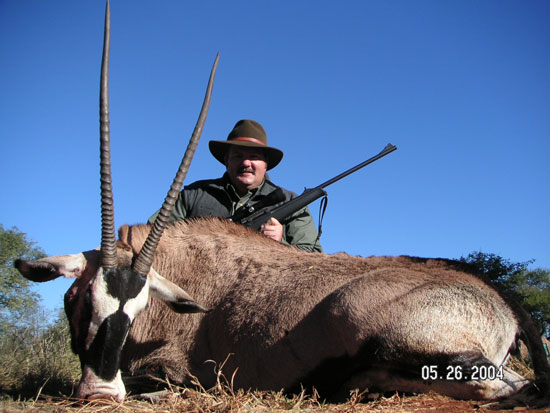
Author with his Gemsbok.
Day Two
Blue Wildebeest
Connochaetes taurinus
“Death from Afar”
Less than an hour into our second day (May 25, 2004 @ 7:45am) on Safari we encountered a very healthy looking seven- year-old Blue Wildebeest. Schalk spotted him as he was walking along a fire road sunning him self and looking for a suitable female. We were still in the vehicle and he was about 600 yards away when we turned to our left and saw him. Schalk quickly backed up and parked the truck out of sight of the Wildebeest. It appeared that the Wildebeest didn’t see us or at least wasn’t bothered by the sight of the vehicle. Schalk grabbed the shooting sticks and we headed off on foot towards the Wildebeest. Quietly walking through the bush we traveled about 300 yards before Schalk peeked out on the road to see where our quarry was. Schalk saw our game still walking the road and carefully set up the sticks. As the shot was going to be on the long side, I cranked the scope up to six power and nestled the rifle in the crotch of the shooting sticks. The Wildebeest seemed curious about us. When he spotted us we stood still and he stopped and turned slightly to his left. When he did I shot him in the front on his right shoulder. He staggered slightly and ran off into the bush. Schalk said “He’s dead” and we walked back to retrieve the Land Cruiser. As we walked back to the truck Schalk said “That was a good shot, we’ll measure it so no one can say we’re full of it”. We drove to where the Wildebeest was hit and started our search. Within two minutes Schalk found him. He had gone 30 – 35 yards into the bush before collapsing dead. The 9.3 mm 286 grain Nosler partition (2575 FPS) had broken his shoulder and most likely penetrated his heart. Schalk measured the shot at 274 yards. I decided on a skull mount (27 inch spread) and flat skin for this beautiful animal.
Zebra
Equus spp.
“Zebra Tuesday”
Not even 45 minutes after taking the Wildebeest we came upon a nice looking three-year-old Zebra stallion. No time to exit the vehicle. I shot quickly and hit him in the right shoulder. It was a quartering shot. As soon as I fired I cycled the bolt and was about to shoot him again as he turned to run away but then Schalk said, “He’s dead. Don’t shoot. You broke his shoulder”. We found him lying dead 100 yards away from where he was hit a very beautiful and tough animal in deed. The distance was about 80 – 90 yards. We later recovered the 9.3mm 286 grain Nosler Partition. It performed as advertised with a perfect mushroom shape remaining. His skin was gorgeous and will be a prime flat skin example. I coined this day as “Zebra Tuesday” because all four hunters in our group would take Zebra this day.
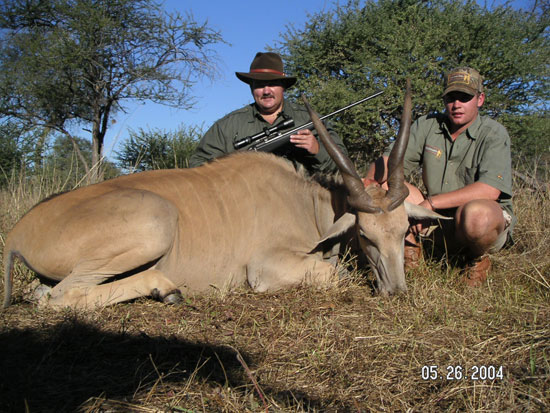
Robbie and the Author with his Eland Bull.
Day Three
16.5” Blesbok
Damaliscus albifrons
On Wednesday May 26, 2004 our goal was Blesbok and Gemsbok. After chasing four different herds of Blesbok for several hours it was beginning to look like this day would not be the day for a trophy animal. Each time we encountered a group of Blesbok we found that either there were no good rams in the group, or that they would take off the moment they spotted us. At one point our focus shifted to Gemsbok as Schalk spotted a big bull hidden amongst some thick bush. By the time we could verify the quality of this animal’s horns I no longer had a shot at him. Back we went to our search for the beautiful Blesbok. Shortly before we were to head back in for our mid-day break Schalk saw a herd that we were able to sneak up on. We spent a few minutes watching an old ram chase several females around until the ram presented a broadside shot. Other members of the herd would walk in front of the target or he would move around. Most of the time the ram was partially obscured by bush so it took some time before I could even consider shooting. Schalk watched through his Leica binocular as he guided me to shoot. The distance was 130 yards so I brought my scope to six power and waited until I had the perfect shot. My 9.3mm 285 grain Swiss CDP bullet hit the ram in the upper chest, breaking his spine and continuing straight through. He dropped dead without taking a step. The time was 10:45am. For Schalk and me, this particular hunt stands out because of the perfect communication between us in executing this challenging hunt. My EAR electronic earplugs were an outstanding asset on this Safari as I could always hear what my PH was saying and yet I always had protection of my hearing whenever I or anybody else took a shot. This beautiful Blesbok will be honored with a full shoulder mount.
32” Gemsbok
Oryx gazella
The hunt for Gemsbok continued in the afternoon as we searched the bushveld for sign of a good candidate. Late in the day we were surprised to spot a small herd moving quickly from right to left about 90-100 yards in front of us. The time was 4:45pm and the sun was just above the horizon shinning right in our eyes. Schalk stopped the truck as soon as he saw the Gemsbok and quickly glassed the herd so as to select the appropriate animal for me. As he did so, I made ready to shoot and was struggling with the sun. Schalk said, “He’s a good one… shoot”. I could not get a good sight picture and did not shoot. The bull moved on followed by a nice looking cow. At this point I was a bit more prepared to shoot and Schalk said, “That’s a good one too” I fired as the cow ran for cover. It was a rush shot and I hit her a bit too far back. At first I thought I missed completely but Schalk said that I had hit her in the stomach. We immediately started to search for her. We saw no blood and only a little moisture on the ground where the Gemsbok was shot. Near the beginning of the search Schalk and one of our trackers saw her for a brief moment but she ran off and we could find no sign of her after that. By 5:45pm it was too dark to see and we had to mark the spot where the Gemsbok was shot and return to camp for the night with the plan to resume the search for her first thing in the morning. That night, I couldn’t stop thinking about this wounded animal and pondering whether I should have taken the shot or not. Schalk said not to worry, that we would find her in the morning. He felt that she would still be alive and on the move. The plan was to go out with another PH named Robert (Robbie) Maree and two trackers in the morning.
In the morning we headed out and upon arriving at the spot we marked the night before we resumed the search on foot in the hope of finding the Gemsbok cow alive and in good condition. After 30 minutes of searching one of the trackers radioed to Robbie that he located the Gemsbok and we ran to his position. Breathing heavily upon arrival at the spot where the Gemsbok was holed up, I tried to see her as Robbie pointed to a gap in the bush where the Gemsbok stood. I could see that indeed a Gemsbok was standing there but at first I could not tell where her head was and where her tail end was. Then I saw her horns and with a deliberate effort I put the post reticle on the horns and followed them down and slightly left. I fired as soon as I had the post on her neck area close to the head and she dropped straight down dead. The 9.3mm 285 grain RWS SP went straight through. The time was 7:10am on Thursday May 27, 2004 and I was very relieved to have recovered the Gemsbok in what appeared to be pristine condition. Upon examination we could see that the 9.3mm 285 grain Swiss CDP bullet had hit her in the middle of her abdomen just above the centerline. There was no sign of blood on either side of her and just a trace amount of moisture around the bullet holes. Interestingly the tracker found her when he spotted sign on the ground near a bush and crawled in to investigate. When he did, he ran right into the sleeping Gemsbok! She turned her head as he stuck his head through the bush and he actually bumped into the side of her horns. Both animal and tracker were startled and ran off in opposite directions. This beautiful Gemsbok cow will be preserved on a full shoulder mount.
Warthog
Phacochoerus aethiopicus
While driving back to camp after abandoning the Gemsbok search for the night we spotted a Warthog boar rooting about 20 yards from the road. It was 6:00pm and though it was very dark by this time, I was able to see him clearly thanks to the brightness of my Schmidt&Bender 1.5-6X42mm scope. The thick German Post reticle stood out well against the dark form of the Warthog. I placed the tip of the post on his shoulder and fired. Shooting at a 45degree angle to him the 9.3mm 285 grain RWS SP bullet hit him in the shoulder and came out the neck. He dropped in his place straight away. I decided that his skull would be an appropriate trophy in remembrance of this interesting animal.
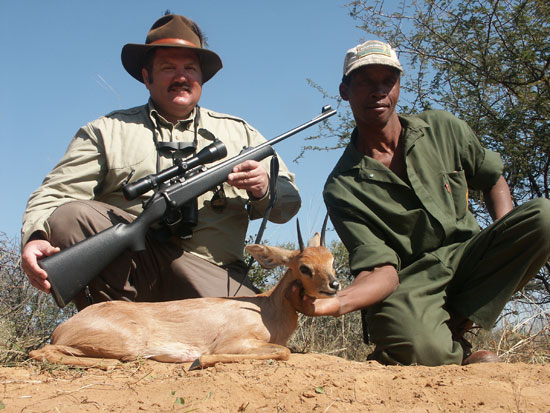
Author with his Steenbok and one of the Trackers.
Day Four
Eland
Taurotragus oryx
Thursday May 27, 2004 started out well as we were able to locate my wounded Gemsbok and get her “in the salt” first thing in the morning. After bringing the Gemsbok in for processing we headed out to the bushveld in search of the elusive Eland. During the morning hunt we saw Eland several times but we could never get close to them. The Eland were always on the move and they detected us several times. The wind was not in our favor and the Eland were particularly wary this morning. After Robbie and the trackers found sign we made several stalks on foot this morning but each time the Eland moved off and we could not keep up with them. We returned to camp at mid-day with the intent to hunt from a blind in the afternoon if the wind was still unfavorable. When we went back out in the afternoon, the wind had died down and we decided to continue the stalk. We soon found Eland tracks and were able to “sneak up” on a small group. Robbie glassed the Eland Bull and pronounced him a suitable specimen. We approached the Eland carefully making sure to stay low and down wind of them. When we got to within 125 yards of the bull Robbie checked one more time to be sure of the quality of the animal. He quickly set up the shooting sticks for me and I set the gun between the sticks and prepared to shoot. I waited until the Eland bull turned slightly and I shot him in the front left, breaking his shoulder. He ran 30 yards and fell dead. Again the 9.3mm 285 grain Swiss CDP bullet did the trick. Upon examining this Eland we found that he was part Livingstone Eland which we could ascertain due to the light colored vertical stripes on its body. This animal’s horns measured 30 7/8” and 29 7/8”. He will make for a nice looking shoulder mount.
Waterbuck
Kobus ellipsiprymnus
For Thursday evening (May 27, 2004) Schalk had a special hunt planned for me. Robbie, two trackers and I were to drive to a farm about an hour from camp for a night hunt on the Limpopo River. We arrived at the farm at 9:25pm. We met the farms owner; a friend of Schalk’s and prepared ourselves for the hunt. Our goal was Waterbuck and Bushbuck. Due to considerable crop losses the farmer possessed a deprivation permit that allowed us to use spotlights and hunt at night. We patrolled the property along the river using the spotlights and spotted a large Crocodile resting on the edge of the river, and a big Waterbuck, on the Botswana side. The bush was very thick in this area and it was difficult to see any animals. After 30 minutes we saw two Bushbuck but they were too far off, moving too fast, and most likely female. We continued the hunt, slowly driving through the bush, ever vigilant for game. It became apparent that we were a bit too early and that our presence was keeping the animals from going to the crop fields from the river area. We left the area to give the animals time to come out and then resumed hunting. At 10:45pm Robbie spotted horns on our side of the river. The Waterbuck was in thick cover and was only partially visible. As Robbie glassed the animal I aimed at the only area I could see that offered a suitable shot. I fired when given the signal. The Waterbuck immediately took off. I couldn’t tell where I hit him but I was sure it was in the upper chest area. Robbie thought I hit him farther back and our host thought I hit him in the right shoulder. It was very dark and hard to really tell anything for sure at that point. We jumped from the Land Cruiser and fanned out in search of the wounded Waterbuck. After about 15 minutes of looking we were questioning how well he was hit and where he was when he was shot. The thick bush and lack of light made it difficult to pin point the exact location. Flashlights were all we could use in the search area. We made the decision to move a bit farther to our right and as we headed back towards the truck we could smell a very pungent odor. It reminded me of the smell of Wild Boar from my hunt in Germany last year. We walked toward the smell and found the Waterbuck lying on his left side. He was dead. He ran 20 yards from where he was when he was shot. The 9.3mm Swiss CDP bullet hit him in the upper chest. We recovered the bullet during processing and discovered that it performed just like it was supposed to with a classic mushroom shape terminating about one third down the length. Robbie estimated the distance of the shot at 60 yards. The Waterbuck’s horns were wide apart and measured 21” and 22”. I decided on a skull mount to preserve the memory of this exciting hunt.
Day Five
Impala
Aepyceros melampus
On Friday, May 28, 2004 I decided to sleep in due to the late night hunt the day before. At breakfast we got word that Greg Haas had taken a Wildebeest and that he and his PH needed us to come pick it up for them. After doing so, Schalk and I headed out to hunt for Steenbok and Impala. Because of my intended game, I changed the barrel on my Blaser R93, installing a 6.5X55 barrel in place of the 9.3X64. Though we hunted hard for Steenbok we never did see any this day. I was also interested in taking another Impala. I wanted the second one to have more standard looking horns (my first one had horns with tips that curved in) and hopefully a brown strip on his nose area. We saw several Impala with the right type of horns but not with both the horns and brown nose area. In the early afternoon Schalk spotted an Impala with a broken horn tip and asked me to shoot it for him. It was a 45 – 50 yard shot from the vehicle. I shot him through the heart. The 6.5mm 156 grain Norma Oryx bullet went clear through and the Impala dropped where it stood. The time was 12:30pm. We continued the hunt for Steenbok and Impala until it approached dark.
Day Six
Impala
Aepyceros melampus
On Saturday, May 29, 2004 Schalk and I set out in the afternoon again looking for a trophy Impala and / or a Steenbok. We had no luck with the Steenbok but we did see several possibilities with Impala without being able to get close to them. Just after 4:00pm we spotted a beautiful Impala ram with great looking horns and we set out on a stalk trying to get a shot at him. We spent a quarter hour following the Impala through thick bush before we got close enough to him to attempt a shot. Suddenly I saw an opportunity at a shot and I jumped out of the Land Cruiser (this one had no front doors on it) and as the ram ran through a gap in some very thick bush I shot him in the neck. It happened so quick that all I could see was a fur patch on his neck and I made a snap shot. The 6.5mm 156 grain Norma Oryx bullet hit him in the middle of the neck and apparently broke his spinal cord as I was told that he dropped straight down the moment he was hit. The distance of the shot was between 55 – 60 yards. This beautiful specimen did not have the desired brown strip on his nose but he had a great set of horns and will make for an impressive shoulder mount.
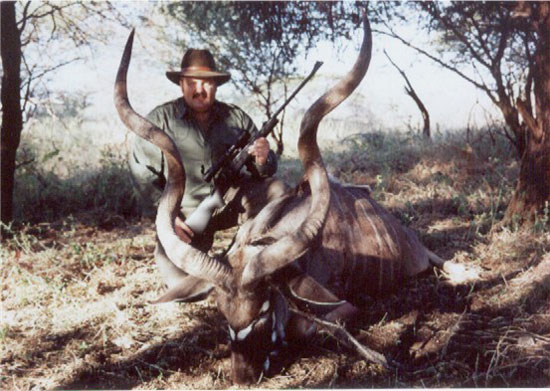
Author and his Kudu Bull.
Day Seven
Ostrich
Struthio cemelus
“Death on the Run”
On Sunday, May 30, 2004 I spent the morning with Greg Haas and Schalk on Greg’s Water Buffalo hunt. After a successful hunt we broke for lunch and then Greg and I headed out for Ostrich guided by another young PH name Jaco Kruger (pronounced Yaw-koo). The hunt for Ostrich began by searching for footprints in the dirt. Once we located tracks we carefully cruised around the bushveld until sighting Ostrich. After about three quarters of an hour Jaco spotted Ostrich tracks which we followed until we saw an Ostrich hen running down a fire road about a quarter of a mile ahead of us. The chase was on! The driver hit the gas and we tore off after her. We were in a late model Toyota 4X4 pickup with two seats mounted midway up the cab to afford enhanced visibility. It was a wild ride! (Editors note, I can attest to how much fun the chase is!) At times we were doing sixty miles per hour. Even at that speed it took a while to gain on the Ostrich. An adult Ostrich can reach speeds over forty miles per hour with the ability to corner much sharper than any off road vehicle is capable of. As we bounced along, trying to hold on I saw that up ahead the road made a ninety degree left turn and I wondered if our driver would slow down enough to make the turn without rolling the truck. Not to worry, he turned out to be an excellent driver and we made the turn beautifully. However, in having to slow down for the turn we lost significant ground on the Ostrich and we had to go all out to catch up to her. When we got pretty close to her I felt fairly confident that I could hit her while we were still moving but I thought better of it as I didn’t think our driver would be able to react fast enough to avoid running over her if I did hit her. When we got within 10 yards or so of her Jaco signaled our driver to slam on the brakes and we came to a quick stop. The Ostrich of course kept running away from us. I rushed my shot and missed her. Jaco said I shot through her feathers but all I know is that I missed. The chase was on again. When we got close to her again she ran to her left and headed into the bush. We came to a stop and I took a little extra time to be sure of my shot. As she ran into the bush I fired. Though partially obscured by bush the 9.3mm 286 grain Nosler Partition hit her right in the spine and she dropped immediately and skidded for some ten and one half steps. The distance was about 50 – 60 yards. When she went down Greg and Jaco were smiling and congratulated me for redeeming myself. The time was 3:30pm. Later on we discovered that the killing shot hit the left mounted antenna. We speculated that perhaps that was why the entrance hole was as big as it was (about three by three inches). Ostrich meat is very delicious and the leather quite pretty as well as durable. This hunt turned out to be a lot of fun as well as a challenge. Before coming to South Africa I never even considered going after an Ostrich. Thanks to Schalk and Greg I’m glad to have had the experience.
Day Eight
Steenbok
Raphicerus campestris
Monday, May 31, 2004. I spent the entire day hunting for Steenbok without success. Nonetheless we had a good time hunting the bushveld for this tiny antelope species.
Day Nine
Steenbok
Raphicerus campestris
“The Smallest But Hardest To Get”
Tuesday, June 1, 2004. I hunted for Steenbok for three hours straight, slowly cruising around the bushveld scanning for a ram. At about 8:30am we saw a nice ram take off running into the bush on our left but had no chance for a shot. Half an hour later we saw another one but he ran off as I prepared to shoot. We also saw two females which are bigger but don’t have horns. At 11:20am I spotted one standing alongside the road no farther than 25 – 30 feet away. He was standing broadside and we almost missed him. We had to back the truck up so I could get a shot at him. My first shot went high and he didn’t react at all when I fired. I neglected to take the parallax effect into account when I took this very close shot. My second shot hit him in the right front shoulder and he took off into the bush. He ran out of the bush and into the road about 30 feet behind the truck. I fired again as he ran wildly back towards the bush and missed. We jumped from the truck and I quickly replenished the magazine (the Blaser holds four and I had fired three). Schalk and I went into the bush to track the Steenbok. Within two minutes I saw the Steenbok step out from behind a bush less than 25 feet away. I immediately turned and shot it in the chest dropping it instantly. I was using the Blaser R93 with the 6.5X55 barrel and Norma 156 grain Oryx bullets. More gun than probably needed, but this little creature turned out to be just as tough as any other game we took on this hunt. For me, Steenbok turned out to be very difficult to harvest. This ram will display nicely as a full body mount on a wall attachment.
Day Ten
Last Day on Safari…
Wednesday, June 2, 2004 was a laid back day for me. Several members of our group were leaving late morning and Greg Haas was making one more attempt at bagging a Kudu. I spent the morning with Schalk and Robbie cruising the bushveld looking for culling shots (didn’t get any) and taking in the lush scenery one last time. The weather this day as on every other day of our Safari was picture perfect and it was very relaxing seeing the animals and birds in their natural habitat. In the evening we settled up with Schalk and enjoyed one more gourmet meal in the lodge reminiscing about our experiences and looking forward to our next destination: Kruger National Park.
Looking Back...
It’s probably a cliché to say that this trip was a “once in a lifetime event” although for some that may be the case. For me however, I intend to go on Safari in Africa again (God willing). Like many have said before, it’s true that once you’ve experienced an African Safari, you’re hooked. I can’t say that happens to everyone but it sure did in my case. Everything about the trip was just great (with the exception of the long flight). South Africa offers wonderful country, magnificent and abundant animals, mild weather, great hunting, and terrific people. Besides offering all of this, it’s also very reasonably priced. I would strongly encourage anyone interested in an African Safari to contact Schalk van Heerden, Bush Africa Safaris bushasaf@lantic.net for more information.