Eric Ching Article 04
A Scout to Snout Encounter
by Eric S. H. Ching
The Mannlicher Collector #67, 2001
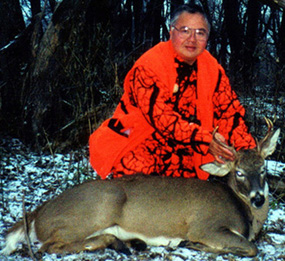
The author with his first whitetail buck
The early deer gun season in North Dakota opened at noon to overcast skies with temperatures in the low 20s and a few inches of snow on the ground. My two hunting partners, who had worked this 8-acre wood lot the year before, told me that it was a like a freeway interchange and rest stop for deer as they moved among the soybean, corn, and wheat fields surrounding it. They had seen no traffic at dawn, but “rush hour” reliably started around 3 o'clock each afternoon.
At 1:30 we settled ourselves on camp stools in chest-high ground blinds, about 50 yards apart, facing north into a light breeze. I was in the middle blind. Several deer trails crossed in front of me, from just on the other side of the deadfall barrier that formed the front of the blind, to 50 yards away at the edge of some thick brush.
Rain during the preceding two weeks had prevented the farmers from harvesting a lot of their crops, so we expected the big bucks to lay up in the fields and not follow their regular patterns of travel between their food supply and the shelter belts where they normally bedded down. With that in mind, and holding an out-of-state antlered-only tag, I had decided to shoot the first legal deer I could and not worry about trophy quality. Memories of my only other whitetail hunt five years earlier in Minnesota, also with an out-of-state antlered-only tag, were still fresh: a solid week of hunting in temperatures ranging from zero to the low `teens didn't produce even a glimpse of a legally shootable deer. I was also eager to blood my Steyr Scout.
The fauna adjusted to our presence after a couple of hours of silent sitting; field mice scampered from hide to hide, woodpeckers engaged in their staccato searches for grubs, owls made their inquiries from the treetops, and a red squirrel chastised me severely from a foot away, perhaps objecting to my sitting near its favorite tree. The cold had started seeping into my hands and feet after an hour of inactivity, and was making good progress through the rest of my body after two hours.
About 3:45 a small fawn wandered in from my right and stopped to look me over from about 10 yards away. He didn't seem alarmed, and stretched his head up, ducked it down, and turned it side to side, trying to figure out what I was. I felt very conspicuous with my upper chest and head, resplendent in blaze orange, completely exposed above the blind's wall. I managed to convince the fawn that I wasn't a threat, and he slowly continued on his way. Fifteen minutes later, two good-sized does trotted past my blind and never seemed to notice me sitting there, only three feet away.
“Rush hour” apparently was upon us. I was now on full alert, and after another ten minutes the tiniest hint of motion to my right caught my attention. My hood limited peripheral vision, but I forced myself to stay still and wait. A few seconds later I was eye to eye with a 3x3 buck, standing right in front of the blind.
I normally think of difficult shooting problems as involving long distances, but this was just the opposite: a shootable buck standing close enough for me to touch its nose with the muzzle of the Steyr Scout's short 19-inch barrel. I was holding the rifle's pistol grip with my thumb on the rotary safety, its buttstock on my right knee and forearm resting on the front wall of the blind, but I couldn't bring the rifle to bear without spooking the deer.
I had no problem evaluating his rack at that distance, of course. I deemed him entirely appropriate for a first whitetail trophy: his three-tined antlers were slender and small, but symmetrical and nicely shaped. Now I just had to hope that he would stop looking at me, back off a bit, and give me a clear shot.
After ten seconds of eyeing me, the buck apparently decided he had nothing to worry about and turned and walked straight away. Time to make my move! I leaned forward as quickly and quietly as possible, hoping the folding camp stool wouldn't creak, braced myself on the blind's front wall, and lined up the sights on the deer's rump. The heavy reticle of the Leupold Scout Scope was easy to see in the fading light against the deer's coat. When the deer stopped 19 yards away and angled left with its head behind a tree, I drifted the cross-hairs forward to its shoulder, took up the slack in the trigger, and pressed the shot off. Five seconds had elapsed.
At the shot, the buck spasmed and collapsed where it stood. Bolt-flicking another round into the chamber, I watched him through the scope, ready for a second shot if needed. After several seconds I saw a couple of twitches, so I stood up and walked toward the buck, rifle at high ready, ready for a finishing shot if needed. Approaching from the rear, I didn't see any further movement as I came up on it, and finally confirmed it was dead by touching its eye with the Scout's muzzle. I was glad that I had dropped it cleanly and didn't have to track it in the rapidly darkening woods.
The buck was in excellent condition, obviously well-fed and carrying a thick coat. The 180-grain Nosler Partition bullet, handloaded to 2500 fps out of the Scout's short barrel, had just nicked the forward edge of its left shoulder and entered the base of its neck on the left side. After taking out the lower half of the spine, it exited a couple of inches further forward on the right side. The wound channel showed the typical Partition profile: a moderate entrance wound indicating that the front core had opened up quickly, and a small exit wound from the rear core acting like a solid after the front core had peeled away.
After all the stories I'd read and heard about the whitetail deer's phenomenal eyesight, hearing, and sense of smell, I was frankly surprised that none of the deer spooked when they saw or passed me at near-contact distances. I had taken no special precautions to disguise myself or my scent. It made me wonder whether the mystique of the whitetail was somewhat exaggerated.
I had achieved my goal four hours into the season: blooding my Steyr Scout with an one-shot instant kill on a nice young buck. We had him field-dressed, skinned, and hanging to cool within a couple of hours, and his venison butchered, wrapped, and in the freezer before noon the next morning. He already has provided two tasty meals and an introduction to the delights of venison for my parents and siblings.
Even though the rack was nothing spectacular, I had the skull and antlers done up as a European mount to memorialize my first North American game animal taken, as well as the blooding of my Scout. It hangs beneath my impala mount, my first African game animal—and first animal ever—taken.
All three of us came away with venison for our freezers, and you can bet we'll be back in that wood lot next November for deer season!